Using Biochar to Protect Your Lake from Blue-Green Algae
Blue-green algae — technically a bacterium called cyanobacteria — has become an increasing problem in lakes across Ontario and beyond. When blooms take hold, they release toxins called microcystins that are harmful to people, pets, and wildlife. Biochar offers a low-effort, research-backed way to reduce those toxins right at your dock.
What Is Biochar?
Biochar is charcoal produced by burning organic material — in this case, sustainably harvested hardwood from the Haliburton Forest in Ontario — at high heat with very little oxygen. The result is a stable, highly porous material with an enormous internal surface area. That porosity is the key: it creates millions of tiny sites where contaminants can bind and where beneficial microorganisms can take up residence.
Unlike activated carbon products used in water filters, biochar is natural, locally sourced, and designed to work passively in open water. It doesn't require power, chemicals, or ongoing maintenance beyond a simple annual routine.
Why Hardwood Biochar Works Better
Not all biochar performs equally in water. Research consistently shows that biochar made from hardwood or agricultural waste outperforms softwood-derived biochar for toxin adsorption. Hardwood biochar has a denser pore structure, greater surface area, and higher chemical stability in aquatic environments — all of which improve both its physical adsorption of microcystins and its ability to support a healthy microbial community over time.
Haliburton Forest hardwood biochar brings the added benefit of local provenance: produced from responsibly managed Ontario forest, it's well-suited to the lake chemistry of the Canadian Shield.
How It Works Under Your Dock
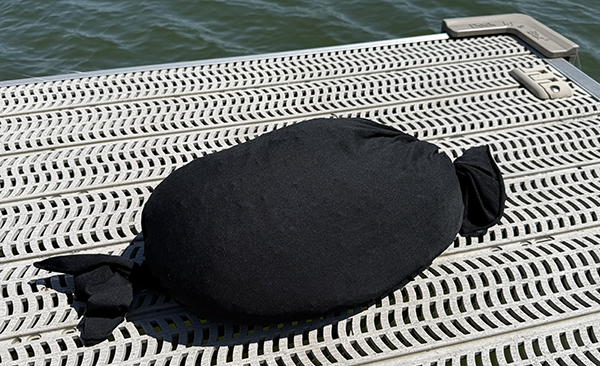
The biochar is supplied in 20-pound permeable mesh bags designed to be submerged in water. Two mechanisms work together to reduce toxins:
Physical adsorption happens immediately. The porous biochar binds microcystins and other cyanotoxins as water passes through the bag, pulling them out of the water column before they can spread or accumulate.
Biological degradation develops over time. As the bags sit in the water, naturally occurring bacteria from the lake colonize the biochar's porous surface. In lakes with active blue-green algae blooms, microcystin-degrading bacteria are typically already present in the water — the biochar simply gives them an ideal place to establish and concentrate. Once colonized, the biochar transitions from passively trapping toxins to actively breaking them down. Research has shown this biologically enhanced biochar can maintain its effectiveness for at least 11 months with no signs of decline.
Nutrient removal is an additional benefit. Beyond toxins, biochar also removes excess phosphorus and nitrogen from the water — the nutrients that fuel algae blooms in the first place. Field studies have documented reductions of up to 98% in phosphorus and 95% in nitrogen in treated areas. This means biochar works on two fronts: cleaning up toxins that are already present while also reducing the conditions that cause blooms to develop.
Installation: Where and How to Hang the Bags
Hang the bags one to three feet below the water surface, where algae activity and toxin concentrations tend to be highest. Our best guidance is one bag per 10-15 feet of dock, spaced evenly.
Attach each bag securely to the dock using rope or a stainless clip so it stays submerged but can be retrieved easily at the end of the season. Avoid placing bags directly on the lake bottom, where sediment can clog the mesh and reduce water flow through the biochar. Also make sure the bag doesn't rub on a dock post or anything that could wear a hole in the mesh bag.
The bags begin working immediately upon submersion. Microbial colonization develops gradually over the first few weeks in the water.
Year-to-Year Care: Washing and Storage
One of the practical advantages of this approach is that the bags can be reused season after season. The key is preserving the microbial community that builds up on the biochar — not destroying it.
-
Retrieve the bags from the water before ice forms or when you close up the dock for the season.
Rinse each bag gently with clean lake water or unchlorinated water. The goal is to remove loose sediment and debris — not to sterilize the bag. Avoid using tap water if possible, as chlorine will kill the beneficial bacteria you want to preserve.
Allow the bags to drain fully. Do not wring or compress them.
Store the bags in a cool, dry location out of direct sunlight — a shed, garage, or covered porch works well. The biochar will dry out over winter, which is fine. The microbial community goes dormant but does not die off.
-
Before hanging the bags, soak them briefly in lake water to rehydrate the biochar and begin reactivating the microbial community.
Rehang at the same depth and spacing as the previous season.
The returning microbial colony will re-establish more quickly than it did in year one, as the organisms are already adapted to your lake's specific conditions.
If you have bags purchased in different years, color code with ribbon or zip tie so you know the age of your bags.
-
Some guidance suggests replacing biochar bags every few months, but this is based on a purely adsorption model — the assumption that pores fill up and the material stops working. Once a healthy microbial community is established, the biochar functions very differently: microbes are actively degrading toxins rather than just trapping them, which means the material doesn't saturate in the same way. Field experience in nearby Lake Roslyn supports multi-year reuse with simple seasonal washing. If you notice a significant reduction in effectiveness after several years — or if the mesh bag itself degrades — that's the time to consider replacing the biochar.
What the Research Shows
Peer-reviewed studies support the effectiveness of biochar for cyanotoxin removal, with some controlled trials achieving over 90% removal of microcystin-LR. Results vary by biochar type, dosage, and water conditions, but hardwood-based biochar (which is what we are using) consistently performs at the higher end of the range.
The biological enhancement mechanism has been documented in a landmark 11-month study (Simsek et al., Environmental Science & Technology, 2023), which found that microcystin concentrations dropped below the detection limit of 0.1 ng/mL after 48 hours of contact with colonized biochar — and that effectiveness held steady across the full study period.
Sources
Lamastra et al. — Influence of biochar on removal of Microcystin-LR and Saxitoxin — Scientific Reports, 2024
Simsek et al. — Nature-Based Solution to Eliminate Cyanotoxins Using Biologically Enhanced Biochar — Environmental Science & Technology, 2023
Oliveira et al. — The Use of Biochar and Pyrolysed Materials to Improve Water Quality through Microcystin Sorption — Water (MDPI), 2020
Chambers — Adsorption of Harmful Algal Bloom Toxins using Biochar — Florida Institute of Technology
McIntyre — Biochar as a Lake Management Option for Harmful Algal Blooms — University of Arkansas
Han et al. — Adsorption and regeneration on iron-activated biochar for microcystin-LR — PubMed, 2021
Princeton Hydro — Harnessing Biochar to Improve Water Quality: Lessons from the Field
npj Clean Water — A comprehensive review on chemical regeneration of biochar adsorbent — 2022